Most drugs work by targeting proteins — blocking an enzyme, binding a receptor, neutralizing a circulating molecule. It's a powerful approach, but it leaves a vast portion of human disease out of reach. Many of the most challenging conditions — rare genetic disorders, neurodegenerative diseases, cancers driven by aberrant gene expression — are rooted in dysfunction that happens earlier, at the level of RNA, before a protein is ever made.
That's where Sanford Labs works.
Research programs
Our research programs are united by a common logic: that intervening at the RNA level offers a new class of therapeutic opportunity — more precise, more flexible, and applicable to diseases that have long been considered undruggable. Across our programs, we are developing the molecules, delivery systems, platforms, and computational tools to turn that opportunity into medicine.
PROGRAM
Enhancing protein expression and activity
The opportunity
Thousands of genetic diseases are caused not by the complete absence of a functional gene product, but by insufficiency — one copy of a gene is working, but a single copy isn't enough to sustain normal cellular function. In these haploinsufficient diseases, the biology is partially intact, which means a relatively modest therapeutic intervention — boosting protein output from the healthy allele — could be clinically meaningful.
Our approach
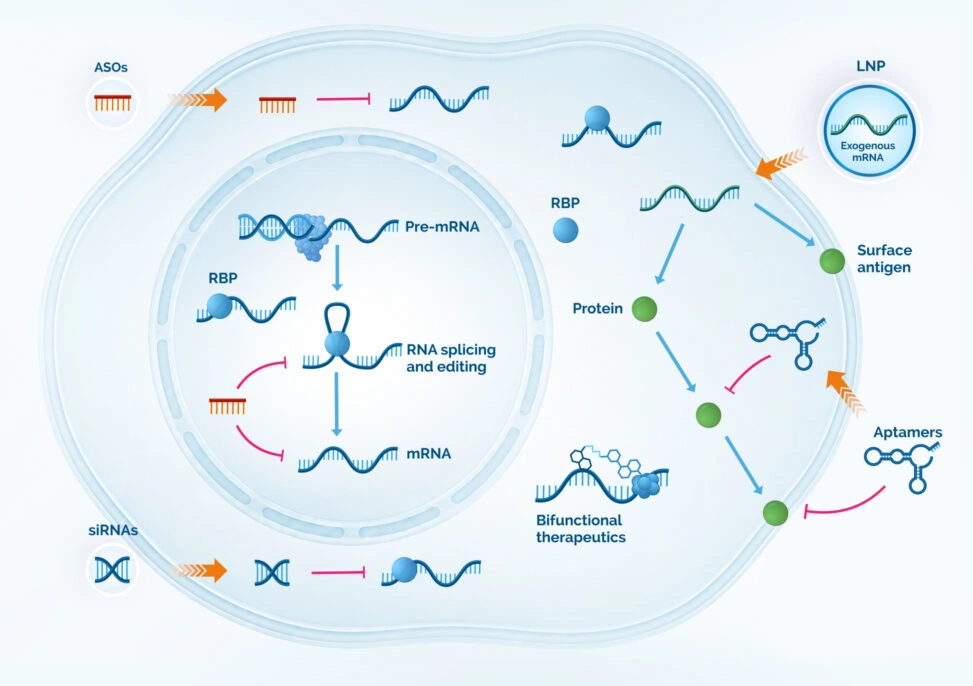
We are developing therapeutics that enhance protein expression and activity from endogenous genes through multiple strategies. One approach uses antisense oligonucleotides (ASOs) to target repressive regulatory elements within an mRNA transcript, thereby relieving translational repression and increasing protein production from the mRNA. We are also pursuing oligonucleotide strategies to overcome haploinsufficiency in specific disease contexts, identifying lead candidates through molecular and functional screening in disease-relevant cell models.
Some of the important drivers of disease — toxic RNA transcripts, aberrant splice variants, or proteins that can't be reached by conventional drugs — have remained stubbornly out of therapeutic reach, because small molecules and antibodies, the workhorses of modern drug development, simply can't access the relevant protein targets. Intervening at the RNA level opens a different door.
Our approach
We are engineering small molecule-based RIBOTACs (Ribonuclease-Targeting Chimeras) that are heterobifunctional drugs designed to selectively target disease-associated RNA. RIBOTACs are designed to simultaneously recognize a disease-relevant RNA target and recruit specific cellular machinery to act on it. Depending on the need, that machinery can degrade a harmful transcript, modify its activity, or redirect it. The result is a high degree of selectivity against targets that have been out of reach for conventional drugs.
Regulation of gene expression doesn't end when DNA is transcribed into mRNA. A rich layer of post-transcriptional regulation — governed by RNA-binding proteins (RBPs) and noncoding RNAs — deter mines how, when, and where mRNAs are ultimately translated into proteins. In reverse, binding of an RNA to its protein target is known to modulate protein function in a process known as riboregulation. Disruptions in these regulatory events are increasingly recognized as drivers of neurodegeneration, chronic inflammation, and other conditions where the underlying biology has been poorly understood and largely untreated.
Our approach
We are developing therapeutics that target RBPs, riboregulatory interactions, and the cellular networks they control. Our focus is on diseases where the normal regulatory activity of RBPs has broken down — a form of dysfunction that sits upstream of many conditions and has been largely inaccessible to conventional therapeutics.
While many diseases can be addressed by modulating endogenous RNA, others require introducing entirely new biological functions into cells. In these cases, the goal is not to adjust existing gene expression, but to transiently supply the instructions for a therapeutic protein — whether to replace a missing function, neutralize a pathogen, or reprogram cellular behavior.
Our approach
We are developing an integrated platform for RNA therapeutics, including in vivo mRNA therapeutics, focused on designing and delivering exogenous RNA to drive therapeutic protein expression within the patient. Our initial work includes encoding monoclonal antibodies, with the potential to expand into multiple application areas — including protein replacement and gene-editing therapies. Central to this effort is our ability to engineer RNA molecules for enhanced stability, translation, and tissue-specific activity, together with the development of targeted lipid nanoparticle (LNP) delivery systems to direct expression to specific tissues in vivo.
RNA therapeutics still lack the computational design infrastructure that has accelerated other areas of drug discovery — the predictive tools that would allow researchers to move efficiently from biological insight to optimized therapeutic molecule. RNA is structurally complex, its behavior varies across cell types and biological contexts, and building those tools from scratch requires both deep biological expertise and serious investment in machine learning.
Our approach
We are building a next-generation computational platform tailored specifically to RNA. Combining large language models, structural prediction, and iterative experimental feedback, our AI engine is designed to predict the behavior of RNA molecules in complex cellular environments — and to use those predictions to guide the design of therapeutics that are more precise, more stable, and more likely to work. While the platform is currently being developed in the context of specific programs, our intent is to build a broadly applicable capability — one that accelerates RNA therapeutic design across disease areas and modalities
Advising Sanford Labs' scientific programs is Gene Yeo, PhD, MBA — Sanford Labs’ Chief Scientist and Professor of Cellular and Molecular Medicine at UC San Diego. As a world-renowned investigator in RNA biology and seasoned entrepreneur, Gene’s research has advanced the understanding of several neurodegenerative diseases including ALS, Huntington's disease, and myotonic dystrophy, and he is a founder of several RNA biotech companies.
We are actively seeking collaborators and partners who share our conviction that RNA represents one of the most exciting frontiers in therapeutic development.
Whether you are exploring licensing opportunities, co-development, or early-stage collaboration, we would welcome a conversation.